How to Study for a Math Test: A Complete Guide for Kids & Parents
I can bet you don’t need relentless hours to study for a math test when you know these six strategies.


A Math test can be tough. You cannot just cram things and hope it works. You cannot predict which questions will appear. And you definitely cannot ignore math for a year and then try to fix everything the night before the test. It does not work like that.
Good math tests check whether you understand the idea, not how well you memorized an example.
Research in cognitive psychology shows that cramming creates short-term familiarity, but very weak long-term retention. Techniques like spaced practice and retrieval practice consistently outperform rereading or last-minute revision.
That’s why students who score well are not always the ones studying the longest. They’re the ones studying the right way.
In this guide, I am going to walk you through six strategies that have genuinely helped students effectively study for a math test and score better. And yes, I have the evidence!
We will also discuss how math test preparation differs for school tests, state exams such as STAAR and SBAC, competitions like Math Kangaroo and AMC 8, admission tests like SSAT, and more.
6 Proven Strategies to Score Well in a Math Test
1. Fix Your Foundations and Start Solving
Rome was not built in a day, and neither is mathematical understanding. You cannot compromise on concepts and expect to do well on a math test. Every topic rests on something that came before it.
Take a simple example. If a child does not clearly understand what 7 ÷ 2 means, fractions will always feel confusing. Because 7 ÷ 2 is 3½. That is already a fraction. And if fractions are unclear, ratios and percentages start to feel harder than they should.
Or think about something even more basic. If multiplication tables are shaky, solving 24 × 15 becomes stressful.
The child is not struggling with the method. They are struggling with the foundation.
Small gaps do not stay small. They grow.
A weak base in division affects fractions. Weak fractions affect percentages. Weak percentages affect algebra. By the time the student reaches higher grades, the difficulty looks new, but it has been building quietly.
Watch how a basic concept can be taught/learnt:
Once you see the gap, do not sit there rereading the chapter. Start solving.
- Go back to the exact type of problem that feels unclear.
- Solve a few straightforward ones first.
- Watch where you hesitate.
- Fix that step.
- Then try the same concept in a slightly different question.
2. Study Math in Groups
Studying math with peers can directly improve performance in a math test when done properly.

Why this works:
- Students can ask questions and have immediate peer discussion, combined with verified solutions, which helps catch misconceptions early. Mistakes are corrected early, so they don’t resurface in a math test.
- Explaining a method out loud strengthens clarity. If a student can justify each step, they are more likely to recall it confidently during a math test.
- Group study builds accountability. When others are relying on you to prepare, practice becomes more consistent.
- The shared environment reduces isolation, lowers stress, and improves focus before a math test.
One rule: Solve individually first, then review together.
3. Make a Cheat Sheet
No, you are not carrying it into the exam hall.
But make one as if you could.
Create a one-page cheat sheet (or chart) that includes:
- Important formulas
- Key equations
- Theorems
- Common identities
- Short chapter summaries
- Mistakes you tend to repeat
If you cannot summarise a chapter on one sheet, you probably do not yet fully understand it.
I've created a reference cheat sheet for you, take a look:
Now double down.
Paste that sheet near your study table. Read it multiple times a day. Cross it at least 8–10 times casually. Morning. Evening. Before solving. After solving.
This combines flashcards and lecture notes.
Whenever you realise you forgot a formula or mixed up a rule while solving, add it to the sheet. Highlight patterns you keep confusing. Update it actively.
Now, for a high-school math test, especially in topics like Algebra, Trigonometry, or Calculus, you do not get time to “think back” slowly to your notes. Retrieval has to be quick and stable. A cheat sheet trains that memory.
You may not carry it into the exam hall. But if you have built it properly, you won’t need to.
4. Practice Under Time Pressure
Understanding a concept is not enough if a student cannot complete a math test within the time limit. If students practice without any time awareness, the first real experience of pressure occurs in the exam hall. That should never be the first attempt.
Timed practice builds familiarity.
For example, if it takes 12 minutes to solve eight algebra problems today, that number becomes a benchmark. Over the next week, the aim can be to complete a similar set in 9 or 10 minutes without increasing errors.
Quick interruption: A math test is not a race, but it should not feel unfamiliar without timed practice.
5. Make Mnemonics Your Friend
You know you'll remember PEMDAS till your last breath. And SOH-CAH-TOA? That one is practically a bedtime lullaby.
In a math test, you do not always have time to rederive everything. So I say, make Mnemoics your friend.
Here are some classics worth remembering:
| Concept | Mnemonic |
|---|---|
| Order of Operations | PEMDAS |
| Trig Ratios | SOH-CAH-TOA |
| Types of Angles | “Acute is Cute” (less than 90°) |
| Greater Than / Less Than | “The symbol eats the bigger number” |
| Factors of 10 | “Just add a zero” |
| Multiplying Signs | “Same signs stay, different signs change” |
If all else fails and you’re still waiting for that one magical trick… It’s time to bring this in.
6. Find Yourself a Math Tutor
A good math tutor is a blessing we often don’t count.
Sometimes students don’t need more practice. They need a clearer explanation. A tutor can quickly identify gaps, explain concepts differently, and guide focused practice. That kind of support builds confidence before a math test.
Find Yourself a Math Tutor
Give your child structured support that strengthens concepts, builds speed, and improves math test performance. Try a FREE live Cuemath class today.
Book a Free ClassFor Students in Grades K to 12 Worldwide
If you are considering one, you might want to explore our detailed guide on choosing the best math tutoring support.
 Neelima Kotamraju
Also, remember that there are countless online resources available. From ebooks and structured notes to video tutorials, students today have access to tools that can help them get back on track.
And you should have your confidence back by now.
School Math Tests vs. Competitive Math Challenges
If you are preparing for a regular school math test, the six strategies we discussed can make a significant difference. Strong foundations, consistent practice, timed solving, mnemonics, structured revision, and the right support often work wonders for syllabus-based exams.
But once you step into competitive math challenges or admission-based tests, preparation needs to be more defined.
In other words, math test preparation is not one-size-fits-all. It should be tailored to the test type and the available timeline.
Let’s break down the major categories and understand how to prepare for each.
1. State Standardized Tests (STAAR, SBAC, NJSLA, GMAS, IAR, AASA)
State-standardized tests assess whether students are meeting grade-level math standards. These exams are usually aligned with the school curriculum and test core concepts taught throughout the year. Examples include STAAR and the Smarter Balanced Assessment Consortium (SBAC).
How to Prepare:
For state standardized tests, the six strategies discussed earlier work extremely well.
Preparation should focus on:
- Strengthening weak chapters first
- Practising mixed problem sets across topics
- Reviewing past paper formats
- Timing small sets of questions
- Analysing mistakes carefully
When to start:
2-3 months out, ramping to daily in the last 2 weeks.
Read how Pranava became a masters grade level achiever:
 Cuemath
Preparing for a State Math Assessment?
Build grade-level mastery with structured practice, targeted gap-fixing, and timed revision. Help your child approach their state math test with clarity and confidence.
Start Structured Test PrepAligned With School Curriculum | Grades K–12
2. Math Competitions: Math Kangaroo & AMC 8
These are enrichment contests for Grades 1–12 designed to stretch mathematical thinking beyond the school curriculum.
- Math Kangaroo typically features 24 quirky, logic-heavy problems with multiple-choice answers.
- AMC 8 has 25 rigorous questions and often acts as the first step toward higher-level Olympiads.
They test pattern recognition, logic, elimination skills, and time management under pressure.
How to Prepare:
- Do past papers weekly: Review mistakes by type, not just topic.
- Learn to Skip Fast:
In both Kangaroo and AMC 8, easier questions are usually front-loaded. Train students to:
- Spend no more than 30–45 seconds deciding whether to attempt
- Skip aggressively
- Return later
Getting stuck early kills momentum.
- Practice Elimination.These are multiple-choice exams. If you can eliminate 2 wrong options, your odds double. Many students forget this is a strategy exam, not just a solving exam.
- Reverse Engineer Answers.Plug answer choices back into the question. For algebraic or numeric questions, this is often faster than solving fully.
When to Start:
Begin 4–6 months ahead.
For the first few months, focus on exposure and reasoning. One month before the event:
- Increase timed sets
- Practice full-length mock tests
- Simulate exact exam conditions
Read how Shaurya became a National Rank 9 Achiever in Math Kangaroo:
 Cuemath
Preparing for Math Kangaroo?
Strengthen problem-solving skills, master non-routine questions, and build speed with structured competition prep. Give your child the edge they need.
Start Competition PrepDesigned for Math Kangaroo & Other Enrichment Contests
3. Admissions & Gifted Ability Tests: SSAT, MAP, CogAT
These are selective screening exams used for admissions or gifted identification.
How to Prepare:
- Use adaptive practice tools: Official SSAT books and MAP-style simulations help students adjust to changing difficulty levels.
- Blend visual + verbal reasoning: Especially for CogAT-style questions where patterns and logic matter as much as math.
- Practice mixed-format sections: Students must switch quickly between word-based reasoning and numerical solving.
- Take a full mock 1–2 times per month: Focus on pacing, not just accuracy.
- Work across formats: Many students are strong in computation but weak in the crossover between verbal and math. Practice translating word-heavy reasoning into structured steps.
When to Start:
Begin preparation 3–6 months before application deadlines.
For MAP and CogAT, which are often school-scheduled, preparation should be more ongoing — steady reasoning practice throughout the year works best.
 Cuemath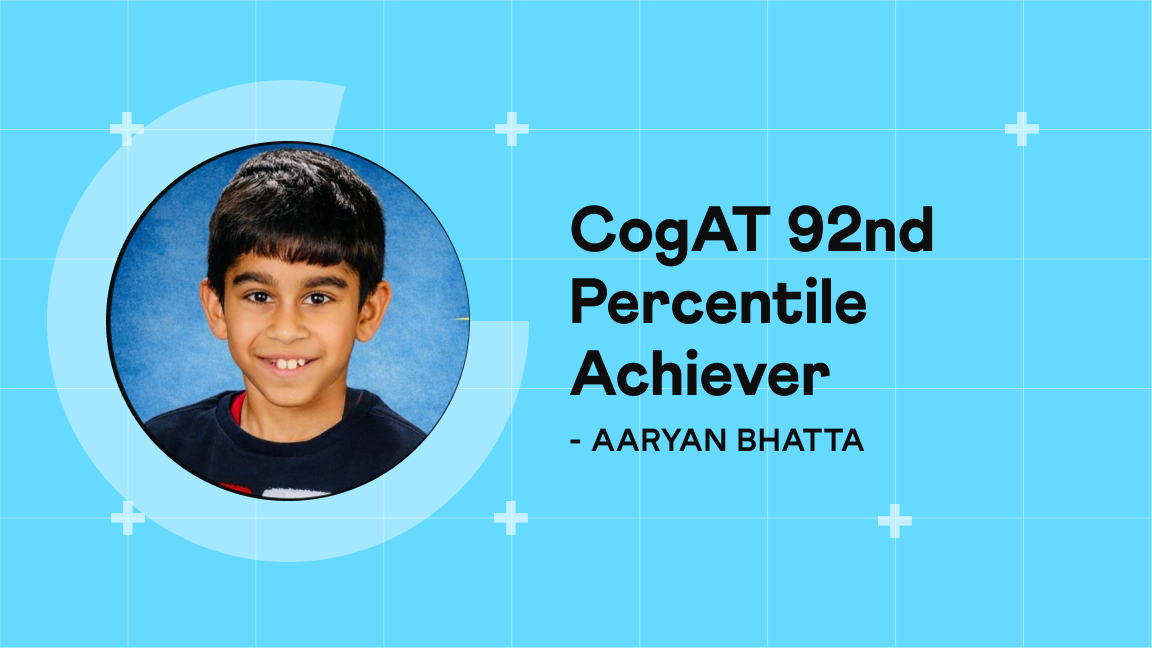
Preparing for the CogAT?
Strengthen quantitative, verbal, and non-verbal reasoning skills with structured aptitude-focused practice. Help your child perform confidently on gifted ability assessments.
Start CogAT PrepFocused on Reasoning, Patterns & Logical Thinking | Grades K–12