10 Best Math Apps for Kids in 2026 That Build Strong Foundations
Looking for the best math apps for kids? This list compares 8 apps based on fun learning, interactive games, core math skills, habit-building, quick tools, and live tutoring.

What is your child’s favourite app right now? Is it Minecraft? YouTube? Toca Boca World? And more importantly, how much screen time do they spend on it each day?
What if some of that screen time could actually help them learn?
Math is one of those subjects where early fundamentals matter a lot. If concepts are shaky in the beginning, children often struggle later. And let’s be honest, making kids sit with books and worksheets can only go so far. This is where the best math apps for kids come in handy.
Instead of pulling children away from screens altogether, the right app can turn playtime into learning time.
The real question parents often struggle with is which math app actually has everything their child needs? Something fun, interactive, builds strong fundamentals, encourages regular practice, and does not feel like extra homework.
After researching dozens of math apps and studying how children actually learn, I’ve shortlisted 10 of the best math apps for kids. In this guide, I’ve broken down what each app offers, who it is best suited for, and how to use it effectively. Mind you, some of these apps can even get you addicted to math.
Key Takeaways (TL;DR)
- The best math app depends on your child’s learning style, pace, and need for structure, practice, or motivation rather than popularity alone.
- Cuemath stands out as the best math app for kids by combining structured learning, guided expert tutors, visual explanations, and personalised pacing for long-term mastery.
- Early learners benefit from apps like Khan Academy Kids and Funexpected Math, while SplashLearn and IXL support regular, curriculum-aligned practice for elementary students.
- Gamified apps such as Prodigy and DragonBox work best for engagement and revision, especially once core concepts are already understood.
How to Pick the Best Math Learning App for Kids?
With so many learning apps available today, choosing the right one can feel overwhelming. The best math apps for kids are not always the most popular ones. They are the ones that match a child’s learning needs, age, and daily routine.
Here are the key factors parents should consider before making a choice.
1. Learning Style
Think of it like YouTube. If your child understands better when concepts are explained visually and step by step, choose an app that focuses on explanations and concept building. If your child prefers solving problems quickly and learning by practice, a drill-based app may work better.
2. Age Fit
Quick check: Does your child enjoy stories and characters, or do they prefer clear instructions and challenges? You have your answer.
3. Fun vs Learning
A lot of math apps look fun on the surface, but that does not always translate into real learning.
A simple way to tell the difference: If your child can explain what they learned after using the app, it is doing its job. If they only remember the game and not the math, the learning may not stick.
4. Online Access
Some apps work like streaming platforms and require an internet connection at all times. Others allow content to be downloaded.
If your child uses a tablet during travel or has limited internet access, offline lessons and practice can be very useful.
5. Budget
If your child only needs light practice, free apps may be enough. If they need structured learning or long-term support, a paid app may offer better value.
Now let’s review the eight best math apps for kids and decide where each one fits best.
List of 8 Best Math Apps for Kids
This roundup of the best math apps for kids isn’t built for just one kind of child. It includes apps for kids who struggle with math, those who enjoy showing up for a small daily challenge, kids who learn best through games, and those who do better with structured guidance. Here’s a closer look.
1. Cuemath (Rating: 4.6)
Why it stands out:
Cuemath brings together interactive lessons, logic puzzles, speed-based challenges, and progress tracking in one cohesive learning experience. This makes it an undeniably strong choice among the best math apps for kids, especially for building solid foundations early on.
Interactive math game in the Cuemath app showing a visual fraction-learning activity.
Who is it for:
Well-suited for primary and middle school kids who need a strong understanding of math fundamentals. Mostly opted for by parents looking for a long-term learning program instead of one-off practice apps.
Availability:
- Android
- iOS
- Global Presence
Top features:
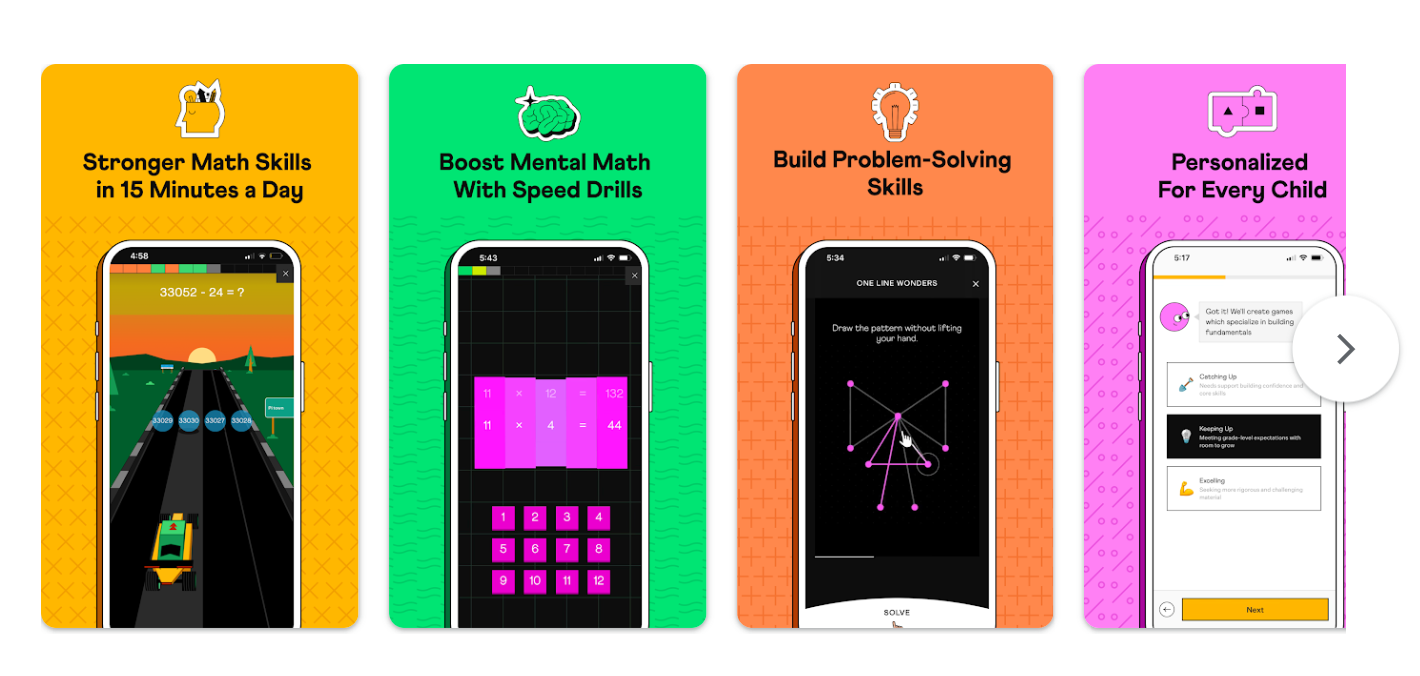
- 15-minute daily learning sessions: Short lessons that fit easily into daily routines while helping children stay focused and consistent.
- Interactive math lessons and logic puzzles: Concepts are explained step by step, helping children understand how and why methods work instead of memorising answers.
- Live interaction with expert tutors: Children can attend guided sessions with trained math tutors to ask doubts, get concepts explained in depth, and receive personalised feedback.
- Speed-based challenges: Timed drills improve calculation speed and accuracy, which prepares them for assessments.
- Personalised learning paths: Lessons and practice sets adapt based on each child’s needs and progress.
- Progress tracking and rewards: Daily progress tracking, badges, and unlocked lessons help keep children motivated and engaged.
What users say:
This is a good and useful app 👌 I take Cuemath classes from almost 4 years and they are very very useful I recommend these classes to everyone whose mathematics is weak not only them children who know mathematics well can also join to practice and learn new concepts faster and faster. Besides that there are puzzles riddles etc. that we do in every class. I enjoy very much in the classes. The teachers are also very good and they make us understand the concept easily. So here is a five star ⭐⭐⭐⭐⭐
Shradha Jain, a MathFit Child.
2. Prodigy Math (Rating: 4.4)
Why it stands out:
Prodigy is a game-based math app where kids fight monsters, complete quests, and level up by solving math problems. It feels very close to a video game, which makes it especially appealing to kids who enjoy play-first experiences, including the ones who might not be particularly drawn to math.
Who is it for:
For elementary- to middle-school kids who already know the basics and mainly need motivation to practice.
Availability:
- Android
- iOS
- Global presence
Top features:
- Game-based learning world: Children solve math problems to battle monsters, complete quests, and progress through the game. Although advanced features are also gated behind a paid membership.
- Adaptive difficulty: The app adjusts question difficulty based on the child's performance.
- Parent dashboard: Lets parents track activity, topics practised, and overall progress.
What users say:
Highly recommend! Works well, and engages kids to do their practice. I do wish there were higher grades than the current ones though ( as of now, up to year 8). I get it's a game, and that older kids aren't really the target audience, but I feel a lot of teenage students could benefit from a tool like this, that deeply encourages learning in a fun way.
Amber Gabites
3. Khan Academy Kids (Rating: 4.6)
Why it stands out:
Khan Academy Kids offers completely free, ad-free access to early math learning, making it one of the most accessible math apps for young children.
Who is it for: Designed for children aged 2–8 years, especially preschoolers and early elementary learners who are just starting with numbers and basic math concepts.
Availability:
- Android
- iOS
- Free to use globally
Top features:
- Free learning platform: No subscriptions, hidden costs, or in-app purchases. This feature makes it one top contender for the best app for kids.
- Early math concepts: Covers counting, number sense, addition, subtraction, and shapes.
- Character-guided learning: Friendly characters help children navigate lessons independently.
What users say:
This is a great app for toddlers and little ones. No Ads anywhere. And the app is free (thank you)! So I highly recommend the Khan Academy Kids app. The app is very well made and it makes very simple requests that are easy for a little one to follow. Plus I love the reward system. My kiddo loves playing with the bugs, she's very happy to just sit and put them in the container and then drag them back out. Thanks for creating a safe space for my kid to play and learn. :)
Erica Roark
4. Splash Learn
Why it stands out:
SplashLearn offers a large library of curriculum-aligned math content delivered through 4,000+ interactive learning games.
Who is it for: Built for kids ages 2–11 and designed for PreK-Grade 5 students.
Availability:
- Android
- iOS
- Available globally
Top features:
- 4,000+ interactive fun activities: Covers a wide range of topics from numbers, shapes, counting, sight words, etc.
- Worksheets and offline practice: Printable worksheets help balance screen-based learning with offline revision.
- Easy Progress Track: Tracks activity, accuracy, and curriculum progress.
What users say:
Honestly, it seems like a great app for kids! Buttons are clear and simple, very colorful, and the music isn't annoyingly repetitive. But almost everything is behind a pay wall. I'm fine with having only some features free; you need to make money. But two games a day isn't much, especially with a toddler. It would be nice if we could at least play the same game more than once a day.
Allison McCloud
5. IXL
Why it stands out:
IXL is a personalised skill development app that covers math from the early years through high school.
Who is it for:
Works best for Grades K–12 students who need structured, repetitive, syllabus-heavy practice.
Availability:
- Android
- iOS
- Available globally
Top features:
- Thousands of math skills: Covers math topics from basic counting to algebra and calculus, broken down into granular skills.
- Immediate feedback: Answer questions in your own handwriting and get immediate feedback.
- Unlimited practice: This allows children to work at their own pace without restrictions.
- Multi-subject learning: Also includes language arts, science, and social studies.
What users say:
I enjoy the education provided for my children. I would though, recommend adding more interactive and colourful features. Thank you.
Najet
6. Dragon Box
Why it stands out: DragonBox is not one app but a collection of game-based math apps, each designed to teach a specific concept through intuitive play. You can easily choose the best math app for kids out of a line of apps they have.
Who is it for: DragonBox works well for kids aged 4 to early teens who enjoy puzzles.
Availability:
- Android
- iOS
- Individual apps available as one-time purchases
- Also available via Kahoot!+ Family subscription
Top features:
- Multiple standalone math games: Includes apps like DragonBox Numbers, Big Numbers, Algebra 5+, Algebra 12+, and Elements, each focused on a specific math area.
- Concept learning through puzzles: Teaches ideas like algebra and geometry through visual puzzles before introducing numbers or symbols.
- Age-specific design: Each app is built for a defined age range, allowing parents to choose based on their child’s level.
What users say:
Excellent app for introducing numbers in a fun way and a great way for children to spend "screen time”.
Barry McAllister
7. Math Learning Centre
Why it stands out:
Math Learning Centre provides a set of visual, hands-on math tools and apps that help kids explore core concepts through manipulation, pictures, and interactive models.
Who is it for:
Best suited for children in the ages of 5 to 11 years (roughly Kindergarten to Grade 5).
Availability:
- Web (browser-based tools)
- Android
- iOS
- Available globally
Top features:
- Interactive math tools: Includes manipulatives like number lines, base ten blocks, fraction bars, geometry shapes, and algebra tiles that kids can move and combine.
- Visual representations: Helps translate abstract math into visual understanding, which can deepen conceptual clarity.
- Free and no sign-in required: Easy to access without accounts or subscriptions.
8. Fun Expected Math
Why it stands out:
Funexpected Math combines structured early math learning with a personal digital tutor, using interactive exercises and voice-based guidance.
Who is it for:
Designed for kids aged 3–7, Funexpected Math is ideal for early learners who are building their first math foundations.
Availability:
- Android
- iOS
- Available globally
Top features:
- Personal digital tutor: A voice-based tutor guides children through lessons, explains concepts, and keeps them engaged throughout activities.
- Skill-building exercises: Focuses on strengthening core skills through repeated practice and interactive challenges.
- Designed for early excellence: Helps children progress confidently toward the top of their age group in math understanding.
9. Monster Math
Why it stands out:
Monster Math focuses on improving math fluency with imaginative stories.
Who is it for:
Best for early elementary kids (roughly ages 5–9) who learn better through stories, visuals, and guided practice.
Availability:
- Android
- iOS
Top features:
- Story-led math learning: Children follow a story where math problems are woven into the narrative, making learning feel purposeful rather than forced.
- Split-screen learning experience: Kids can watch different math stories while simultaneously solving math exercises, helping them connect concepts with context.
What users say:
Only good for revision for older children. There is one basic game and it's the one on the trial. It doesn't help kids work out the answer you just have to know it or keep guessing. The hints just tell you the answer and you get three stars no matter how many times you get it wrong. This just results in guessing and not really learning anything. It still includes numbers above 20 when you had set the settings to just up to 10. If, you are doing revision as an older child it might be useful.
Lauren Carr
10. Photomath
Why it stands out:
Photomath lets students scan math problems and get step-by-step explanations using accurate, teacher-approved methods. But is it the best math app for kids? Let’s find out.
Who is it for:
Best for middle- and high-school students who need help with homework, revision, or understanding solution steps. It works well as a support tool, especially when a concept wasn’t clear in class.
Availability:
- Android
- iOS
Top features:
- Scan problems using the camera: Students can scan handwritten or printed questions to get instant explanations.
- Step-by-step solutions: Breaks problems down clearly, which helps students identify where they went wrong.
- Multiple solution methods: In many cases, the app shows more than one way to solve the same problem.
- Wide topic coverage: Supports arithmetic, algebra, geometry, trigonometry, and calculus.
Quick Comparison Table: Best Math Apps for Kids
| App | 📘 Structured Learning | 🎮 Fun & Games | 🔁 Habit Building | 👩🏫 Live Tutor Support | 📊 Progress Tracking |
|---|---|---|---|---|---|
| Cuemath | ✅ | ✅ | ✅ | ✅ | ✅ |
| Prodigy Math | ❌ | ✅ | ✅ | ❌ | ✅ |
| Khan Academy Kids | ✅ | ✅ | ❌ | ❌ | ✅ |
| SplashLearn | ✅ | ✅ | ✅ | ❌ | ✅ |
| IXL | ✅ | ❌ | ✅ | ❌ | ✅ |
| DragonBox (suite) | ❌ | ✅ | ❌ | ❌ | ❌ |
| Math Learning Centre | ❌ | ❌ | ❌ | ❌ | ❌ |
| Funexpected Math | ✅ | ✅ | ❌ | ❌ | ✅ |
| Monster Math | ❌ | ✅ | ✅ | ❌ | ❌ |
| Photomath | ❌ | ❌ | ❌ | ❌ | ❌ |
Which Math Learning App Should You Choose?
By now, you have probably must be thinking there is no single “perfect” math app for everyone. The table below can help you quickly determine which type of app might work best for your child:
| If your child… | Try |
|---|---|
| 😕 Struggles with core concepts and needs step-by-step guidance | Cuemath |
| 🎮 Loves games and playful challenges | Prodigy Math, DragonBox |
| 🔁 Enjoys short daily practice and routine | SplashLearn, IXL |
| 👀 Learns best through visuals and hands-on tools | Math Learning Centre |
| ⚡ Needs quick help solving problems | Photomath |
| 🌱 Is just getting started with numbers | Khan Academy Kids, FunExpected Math |
Once you’ve identified what your child needs most, the next question is whether you are comfortable managing different apps for different purposes or would rather have one that does it all.
This is where Cuemath stands apart. The Cuemath app is built around structured learning, where concepts are introduced in a clear, curriculum-coherent way and reinforced over time, rather than being picked up in bits and pieces.
Here is how that shows up in everyday learning:
- Visual-aided learning: Concepts are explained using visual models, interactive puzzles, and examples before children move on to solving problems independently.
- Structured Curriculum: Each topic connects to the next, so children are not jumping between unrelated ideas. This curriculum-coherent approach makes it easier to revise, recall, and practice what they have already learned.
- Guided Expert Tutors: Lessons are led by expert tutors who walk your child through concepts step by step. The emphasis is on mastering math concepts with the same tutor over the long term, not rushing through worksheets or guessing answers.
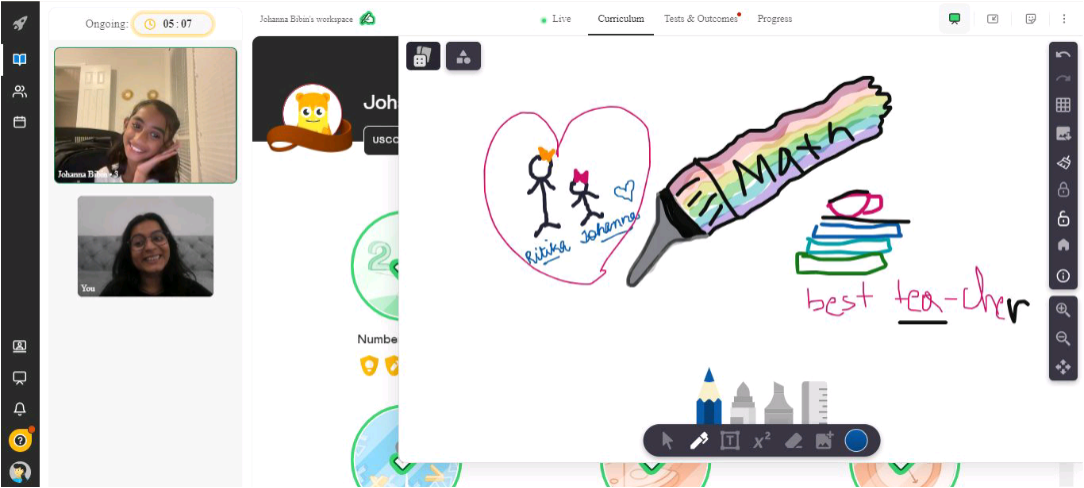
- Personalised for Every Kid: Cuemath adjusts lessons based on your child's performance. If a topic like fractions or equations needs more time, the learning path slows down and offers additional practice and explanation.
- Accelerated programs: If a child is progressing faster, Cuemath allows them to move into more advanced topics. A student who is ready for higher-level algebra does not have to wait just because their school curriculum is moving slower.
That’s why Cuemath is frequently mentioned when people talk about the best math app for kids and one of the most well-rounded math learning apps for kids for long-term learning.
Still Looking for the Right App?
The best math app to make your child MathFit™. Download the Cuemath App for Free.
Download for iOS Download for AndroidFAQs
Do math apps actually improve math skills?
Yes, math apps are highly effective in honing math skills. When used regularly, they help by providing consistent practice, clear visual explanations, and the ability to learn at a child’s own pace. This often helps build confidence and reduce math anxiety over time.
How do I know if a math app is “curriculum-aligned”?
You can tell if a math app is curriculum-aligned when it covers grade-appropriate concepts, follows a clear learning sequence, and includes regular practice through worksheets or structured problem sets.
What’s better: math games or structured practice?
If your child struggles with understanding concepts, structured practice is usually the better choice. Math games work well for quick skill refreshers or when you want to stay productive while on screen.
This is why many parents choose apps that offer both gamified learning and structured practice, with platforms like Cuemath often counted among the best math learning apps for kids.
How much should my child use a math app each day?
For your child’s best interest, treat learning and practice separately. Set aside 30 minutes daily for guided learning to build concepts, followed by another 20–30 minutes for practice or revision.
How do I choose the right level so it’s not too easy or too hard?
Start with apps that assess your child’s current ability instead of relying only on grade level. The right app will start with basic concepts, observe how your child performs, and then automatically adjust the difficulty.
Some platforms, like Cuemath, use ongoing performance tracking to personalise difficulty over time. This means children spend more time struggling and move on once they master a concept.
Can parents track progress and see skill reports?
Yes. Most quality math apps provide parent dashboards that show lessons completed, concepts learned, and performance over time. These reports help parents quickly spot strengths, gaps, and areas that need more practice.
Free vs paid math apps: what’s the difference?
Free math apps work well for basic features like simple games, quick practice, or introducing new concepts. However, when you want structured learning, advanced curricula, and access to locked lessons, a paid upgrade helps.
What’s the best free math app for kids?
If you’re looking for the best free math app for kids, options like Khan Academy Kids, SplashLearn, and Cuemath stand out. All these apps allow children to enjoy games, puzzles, and structured math exercises without ads getting in the way.
In some cases, there are optional in-app purchases if parents want access to specific features, deeper practice, or advanced material, but the core learning experience remains accessible without paying upfront.
Which is better: a math app or a tutor?
Both. While math apps bring games, visuals, and interactive elements that make practice feel less like homework, a tutor helps slow things down and ensures concepts are truly mastered.
Can a math app replace homework help?
A math app can support homework, but it doesn’t fully replace it. Apps are your practice tools, and when homework involves new or confusing topics, a teacher or tutor’s guidance is often still needed.
What’s the best math app for kids who are ahead / gifted?
For children who are ahead, Cuemath works well because it lets them move through topics they have already mastered faster, avoiding repetition of the same curriculum. For example, if a child is comfortable with fractions, they can move on to advanced fractions or tackle more complex, multi-step word problems. This keeps learning challenging while still staying aligned with the school curriculum.
What’s the best math app for kids who struggle or have learning gaps?
For children who struggle with math or have learning gaps, Cuemath works well because learning is personalised to their current understanding.
Guided support from expert tutors helps address doubts as they come up, while visual-aided puzzles and interactive exercises break complex ideas into simpler steps. Progress tracking makes learning gaps visible, so children revisit weak areas through targeted worksheets and practice, rather than moving on unprepared. Over time, this consistent, supportive approach makes math feel more manageable and naturally builds confidence.